

A staggering 65% of adults are considered to be visual learners. This means they prefer to use visual aids and prompts such as diagrams, charts and images to understand and retain information.
Why 'emotions cards' for adults?
Emotion flash cards are a valuable tool for adults because understanding our feelings and finding the right words to express them is often far more difficult than we expect. Although we gain life experience as we age, emotional vocabulary does not automatically develop, and many adults struggle to explain what they are feeling beyond simple terms such as “stressed” or “fine.” The result can be frustration, misunderstandings, and bottled-up emotions.
Visual tools can make this process much easier. It is often suggested that around 65% of adults are primarily visual learners, meaning they process and retain information more effectively when it is presented visually rather than verbally alone. Emotion flash cards harness this preference by turning abstract feelings into something concrete that can be seen, compared, and reflected upon.
Instead of searching for the perfect words under pressure, adults can use the cards to identify emotions, recognise patterns, and organise their thoughts before communicating with others. This externalises complex feelings, making them feel more manageable and less overwhelming.
Whether used independently, with a partner, or in a therapeutic setting, emotion flash cards encourage greater self-awareness and emotional literacy. They provide a practical bridge between what we feel internally and what we are able to say, helping adults communicate with greater clarity, confidence, and understanding. The sooner we dispense with the assumption that adults can simply 'talk', the sooner we arm ourselves with the right tools to help everyone.
![20260605_140135 [amended]_edited_edited.](https://static.wixstatic.com/media/7114e0_aee537be3c49463a8f99ee7351b90a13~mv2.jpg/v1/fill/w_979,h_383,al_c,q_85,usm_0.66_1.00_0.01,enc_avif,quality_auto/20260605_140135%20%5Bamended%5D_edited_edited_.jpg)
How can our 'Counselling Cards' help?
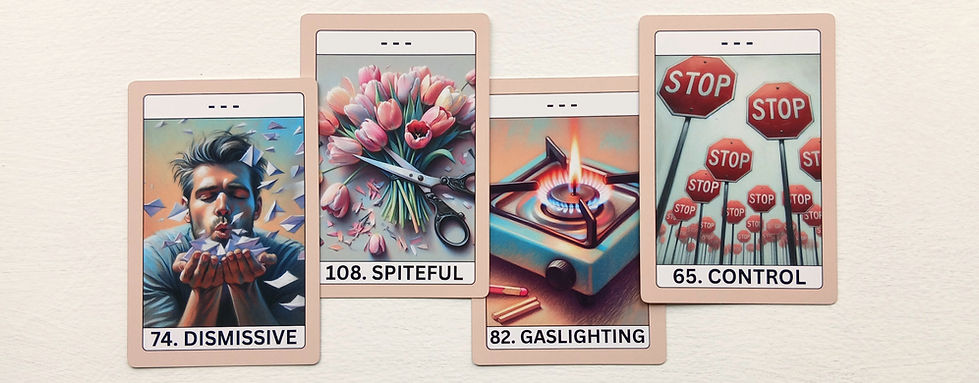
Emotion flash cards can be an extremely valuable resource for counsellors and therapists working with adult clients, providing a practical and accessible way to facilitate clear communication. Many clients arrive in therapy knowing they are distressed but struggling to identify or articulate exactly what they are feeling. Rather than relying solely on verbal expression, flash cards offer visual prompts that help clients recognise and label emotions with greater accuracy.
The cards can also slow the therapeutic process in a positive way, allowing clients time to reflect before responding. This often reduces anxiety and enables more thoughtful, authentic conversations. By selecting and discussing cards, clients may reveal underlying feelings, conflicts, or patterns that might otherwise remain hidden.
For therapists, emotion flash cards provide a shared language and a neutral focal point, making difficult topics feel less intimidating. They can be used to explore emotional complexity, monitor progress over time, and encourage deeper self-awareness. Whether working with individuals or couples, these visual tools help bridge the gap between internal experience and verbal expression, creating a more collaborative, engaging, and effective therapeutic process.
-
How many adults didn't visit therapists today because they couldn't describe how they feel?
-
How does neurodiversity and adult ADHD affect the ability to communicate emotions clearly?
-
How do therapists deal with Highly Sensitive People whose words 'golfball' in the throat?
-
How many adults suffer privately because they don't have the right tools for their learning style?
-
How do therapists amend their approach for the 65% of adults who are visual learners?
-
How do therapists visualise a client's emotional journey if they can't answer questions clearly?
-
How do we bridge the enormous and frightening gap between private pain and public conversation?


